
 Your SUV stalls again on the way to pick up your kids from school. The dealer has “fixed” the same problem three times, but it keeps coming back. When ongoing, warranty-covered defects affect your vehicle’s safety, use, or value, you may be entitled to lemon law protection under California law.
Knowing which car problems qualify for lemon law in California can save you months of frustration and thousands of dollars. The Song-Beverly Act protects drivers when manufacturers can’t permanently fix covered defects after reasonable repair attempts. At The Barry Law Firm, we help families recover 100% of their actual damages when dealerships can’t deliver the reliable transportation you paid for. Contact us today to discover if your repeated repair visits qualify for potential compensation.
Safety-Related Defects That Typically Qualify
When your vehicle has problems that put you and your family at risk, California law takes these issues seriously. Safety-related defects often meet Lemon Law requirements with reduced repair visits, especially when the danger is severe.
Do brake failures and steering problems count even after just one repair attempt?
Yes, these problems definitely meet the requirements when they put you in danger. Brake or steering failures that threaten your safety shouldn’t require multiple failed repair visits. The number of attempts needed depends on how severe the risk is to you and your passengers.
If my SUV stalls or loses power on the freeway, does that count as a dangerous defect?
Absolutely. Stalling, sudden power loss, or engine shutdown while driving creates hazardous conditions that are covered under the law. These problems compromise your vehicle’s safe operation and can make your SUV a lemon. Various types of problems are covered when they affect safe driving.
Will recurring seat belt or airbag warning lights meet the criteria after repair attempts?
Yes, when these warning lights return after repairs, they indicate ongoing safety system failures. These warnings signal that life-saving equipment may not function properly in a crash. If you’re experiencing any of these safety issues, don’t wait for another failed repair.
Can electrical shorts and burning smells be treated as covered safety problems?
Electrical malfunctions that create fire risks, burning odors, or shorts definitely count as dangerous defects. Airbag and electrical failures pose serious risks to occupants. Fire hazards and electrical malfunctions that endanger passengers are treated with urgency under California law.
Do advanced driver-assistance system failures meet the requirements when they behave unpredictably?
Yes, when lane-keeping assist, adaptive cruise control, or emergency braking systems malfunction unpredictably, they create safety risks. These systems prevent accidents, so their failure can make your vehicle a lemon. According to LA County’s consumer protection guidance, safety-impacting failures can trigger protection with less time waiting for fixes when the danger is severe.
Engine, Transmission, And Drivetrain Problems That Qualify
When you’re dealing with the same problem month after month, you need to know if those engine and transmission problems qualify for legal protection. Mechanical defects are among the most common issues that meet California’s Lemon Law standards, especially when repairs fail to provide a permanent fix.
Does excessive oil consumption or engine knocking qualify if the dealer can’t fix it permanently?
Yes, persistent engine troubles like excessive oil consumption, knocking, or burning oil often meet the requirements when multiple fix attempts fail. Under California’s warranty law, manufacturers must provide effective repairs within a reasonable number of tries. When engine defects continue despite repeated shop visits, you may be owed a replacement or refund.
Do rough shifts, slipping gears, or repeated transmission replacements meet Lemon Law requirements?
Transmission issues like harsh shifting, slipping, or complete transmission failures usually qualify under California law. Multiple service appointments for the same transmission problem can establish your lemon claim. Even if the dealer replaces the entire transmission multiple times, continued problems may entitle you to a vehicle replacement or full refund.
If my vehicle goes into limp mode or loses acceleration, does that qualify as a defect?
Loss of power, limp mode activation, or sudden acceleration problems are serious safety-related defects that often qualify. These issues seriously affect your vehicle’s safety, use, and value while creating dangerous driving conditions. When these problems persist after fix attempts, they frequently meet the legal requirements under California Lemon Law.
Do recurring check-engine lights for the same error code count as repeat service visits?
Yes, when the same error code triggers the check-engine light repeatedly, each repair attempt counts toward your lemon law claim. Even if the dealer clears the code temporarily, its return indicates an unresolved defect. Common engine issues like persistent emissions problems or sensor failures often qualify when repairs don’t provide lasting solutions.
For hybrids and EVs, do battery range loss or charging faults qualify when repairs fail?
Electric vehicle battery degradation, beyond normal wear, charging system failures, or inverter problems can qualify under The California Lemon Law. When these issues substantially reduce your vehicle’s range or reliability despite service attempts, you may be owed compensation. Hybrid battery problems that affect fuel economy or performance also usually meet qualification standards when repairs prove ineffective.
Electrical, Infotainment, And Comfort Systems: Do They Count?
Many Californians wonder whether problems with backup cameras, air conditioning, or infotainment systems can qualify under The California Lemon Law. The answer depends on whether these defects substantially impair your vehicle’s safety, use, or value—and whether repeated repairs have failed to fix them permanently.
Can backup camera or screen blackouts qualify if they affect safety or daily use?
Yes, when backup cameras or displays fail repeatedly and create safety risks or meaningfully reduce your ability to use the vehicle safely. Camera failures can meet Lemon Law standards, especially when they involve safety features you rely on for family transport.
Do Bluetooth dropouts and navigation failures meet California Lemon Law criteria?
Software glitches can qualify for protection when they significantly affect the vehicle’s use or value. Persistent Bluetooth failures, navigation blackouts, or infotainment crashes may qualify if they compromise your ability to safely operate the vehicle or seriously reduce its functionality.
Will air conditioning failures qualify during extreme weather conditions?
A/C failures may qualify when they seriously compromise your vehicle’s use or value. Air conditioning problems that persist despite multiple failed fixes may meet Lemon Law standards. This is especially true when they make the vehicle unsafe or unusable for family transportation during hot weather.
Do water leaks and wind noise count as qualifying defects?
Water leaks, excessive wind noise, or door alignment issues may qualify when they meaningfully reduce the vehicle’s use, value, or safety. If these problems persist after reasonable repair attempts and significantly affect your driving experience or the vehicle’s condition, they may meet California Lemon Law defects criteria.
Eligibility Rules: Repair Attempts, Time Limits, And Used/CPO Coverage
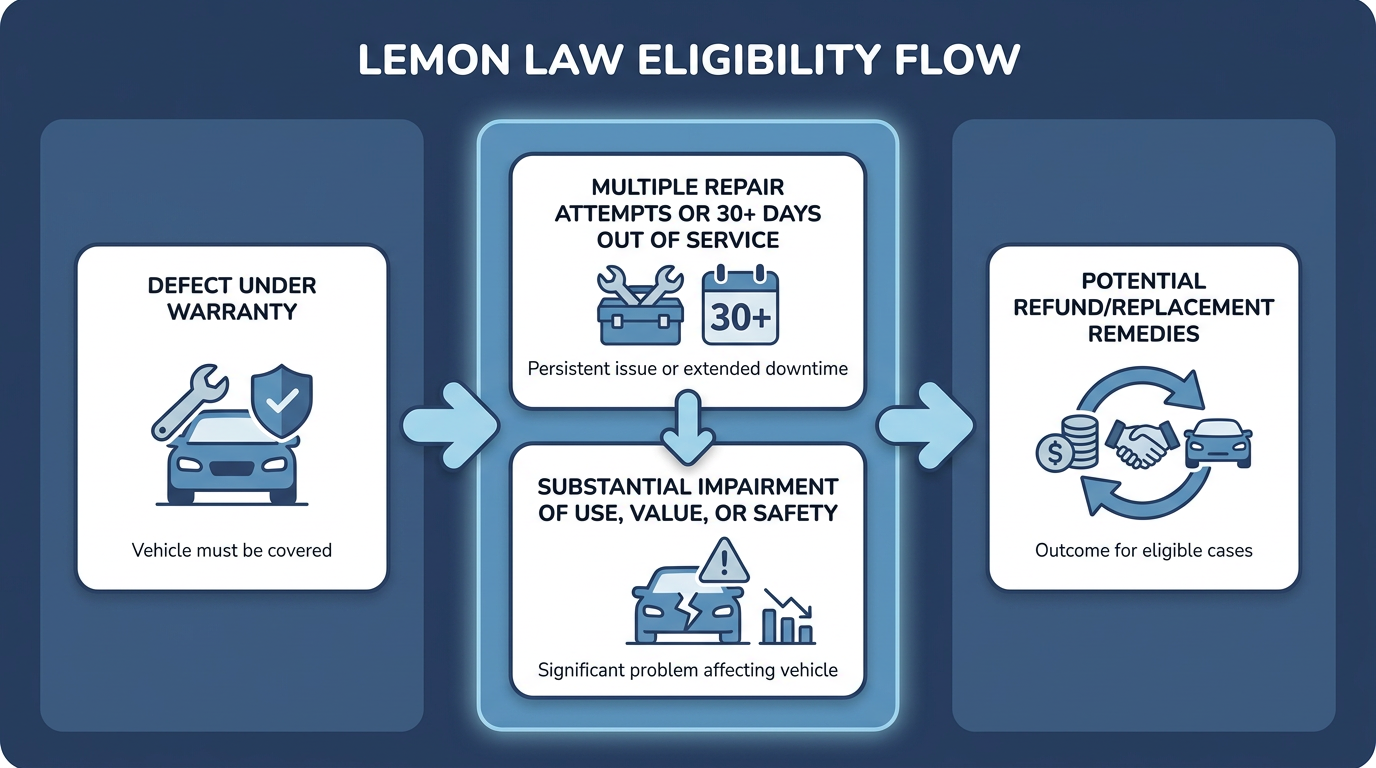
Understanding California’s lemon law eligibility criteria helps determine when your vehicle problems cross the line from annoying to legally actionable. These rules clarify whether your repair history and timeline make you eligible for a refund or replacement.
What counts as a “reasonable number” of repair attempts under California law?
California law presumes your vehicle is a lemon after two or more repair attempts for serious safety defects, or four or more attempts for other covered problems—but only if these occur within 18 months or 18,000 miles of delivery. Even outside this timeframe, multiple attempts for the same issue can still meet the requirements under the general reasonableness standard.
Does having my car in the shop for 30+ days help prove my lemon claim?
Yes, if your vehicle spends 30 or more cumulative days out of service for warranty repairs, this creates a strong presumption that it’s a lemon under California law. The days count from when you drop off your car until it’s ready for pickup, regardless of whether repairs actually fix the problem.
Do certified pre-owned vehicles meet lemon law requirements?
CPO vehicles are eligible when the defect is covered by the manufacturer’s original warranty or an extended warranty. The key is warranty coverage—not whether you’re the original owner. Many families discover their “new-to-them” SUV can pursue a claim because factory warranties often transfer to subsequent buyers.
Can I still pursue a case if my problems started after 18 months or 18,000 miles?
Absolutely. The 18-month/18,000-mile window creates a legal presumption, but you may still meet the requirements under California’s general lemon law standards beyond this period. Time limits for filing claims extend much longer, giving you time to build a case based on repeated repair failures.
What paperwork should I keep to strengthen my potential lemon law case?
Save all repair orders showing dates, mileage, and problem descriptions. Keep records of rental car expenses, photos of defects, and any communication with dealers or manufacturers. Document each day your vehicle is out of service—this timeline provides powerful evidence when demonstrating the impact on your family’s daily life. A consultation at no cost can help determine if your documentation supports a strong case.
Next Steps: Get Free California Lemon Law Help
When your vehicle has repeated safety, engine, or electrical problems that dealers can’t fix, you deserve a reliable vehicle and potentially full compensation for your troubles. State law protects you with specific remedies, and getting the help you deserve is straightforward and won’t cost you anything upfront.
The Barry Law Firm handles California Lemon Law Legal Services with a family-friendly approach that works around your schedule. Our bilingual team handles everything remotely—no need to miss work or arrange childcare for office visits. When your claim succeeds, you’re entitled to 100% of your actual damages while manufacturers pay all attorney fees.
Ready to get your family back on the road safely? Get Free Legal Help Now and take the first step toward the reliable transportation your family deserves.
 Email
Email
 Facebook
 Twitter
 Pinterest