

Your car has been back to the dealer three times for the same transmission problem. Each time, they promise it’s fixed, but the shuddering returns within days. If this sounds familiar, you’re not alone—and you may be entitled to a full refund or replacement vehicle.
Fortunately, California’s Lemon Law protects families like yours when manufacturers can’t fix warranty-covered defects. Knowing how to tell if your car is a lemon in California can mean the difference between endless repair cycles and getting your money back. This checklist gives you clear thresholds, documentation tips, and signs to watch for to protect your family’s safety and budget.
Contact The Barry Law Firm today for a free consultation to learn if you qualify for compensation.
California Lemon Law Requirements: What Counts as a “Lemon” in California
California lemon law requirements center on one key concept: substantial impairment. Your vehicle qualifies as a lemon when warranty-covered defects significantly impact its use, value, or safety. This means problems that make your vehicle unreliable for daily family needs, reduce its resale value, or create safety risks. Minor cosmetic issues or temporary inconveniences don’t meet the standard, but recurring transmission problems, brake failures, or electrical issues that leave you stranded often do.
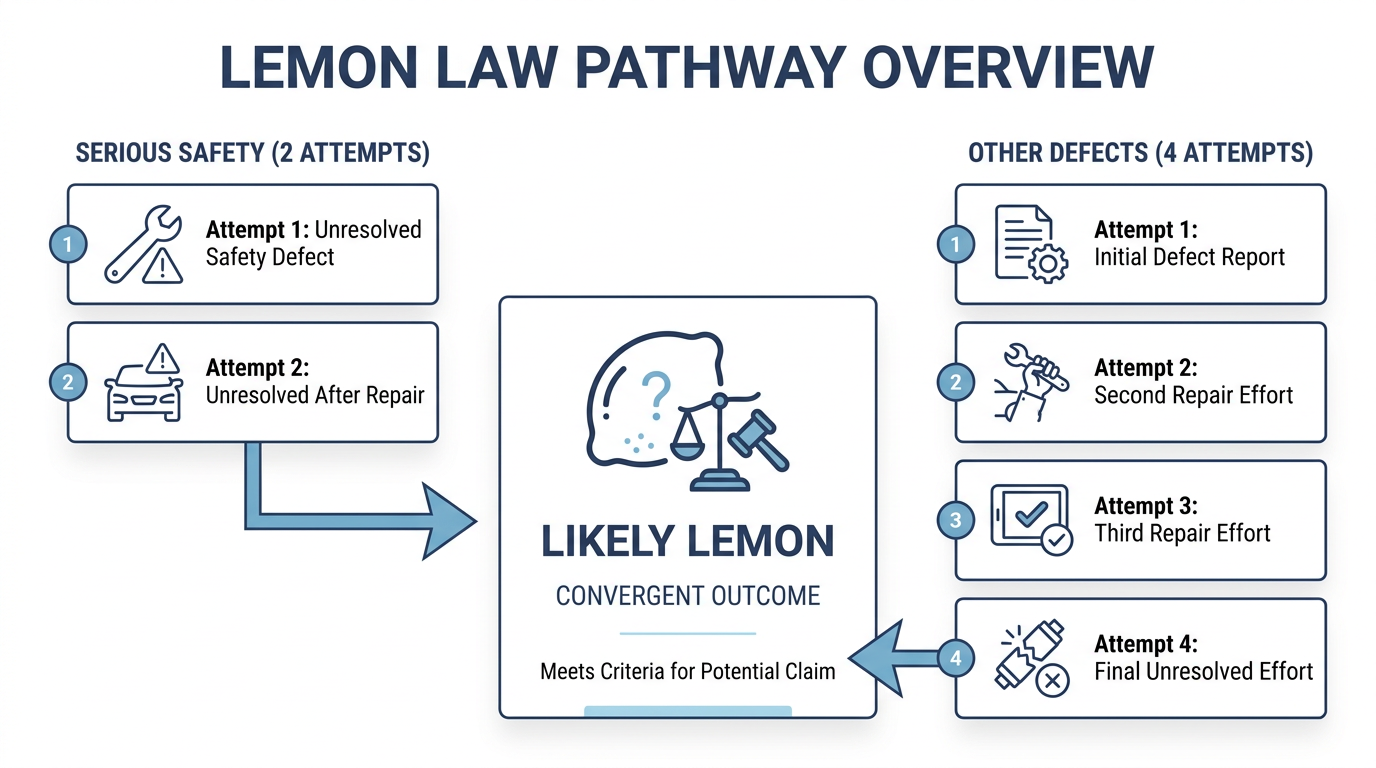
The law creates legal presumptions that work in your favor within the first 18 months or 18,000 miles of ownership. Under California Civil Code § 1793.22, you likely have a lemon if the dealer can’t fix a serious safety defect after two attempts, other defects after four attempts, or your vehicle spends 30 or more cumulative days in the shop. Even outside this window, you may still qualify if the problem started under warranty and the manufacturer had reasonable opportunities to repair it.
(1/13) Confirm Manufacturer Warranty Coverage at the Time of Each Repair
First, make sure your car’s problems happened while under manufacturer warranty coverage. California law requires that defects and repair attempts occur during the warranty period to qualify for Lemon Law protection.
- Check your repair orders show $0 out-of-pocket cost – Warranty repairs should never charge you for parts or labor; if billed, question it immediately and save the invoice.
- Confirm coverage before each dealer visit – Call ahead or check online using your VIN to make sure coverage is still active for your specific problem.
- Save dates when problems started – You may still qualify even if warranty expired later, as long as the issue began during coverage and you reported it to the dealer.
- Remember CPO warranties count, too – Certified pre-owned manufacturer warranties provide the same Lemon Law protection as new vehicle warranties.
- Get written proof of warranty coverage – Ask the service advisor to note warranty status directly on your repair order, and contact us if you have questions about your coverage.
(2/13) Persistent Car Problems: Document Every Recurring Defect
Building a strong lemon case depends on showing a clear pattern of the same defect happening repeatedly, despite service attempts. California law recognizes that persistent car problems that substantially impair your vehicle’s use, value, or safety can qualify for lemon protection when properly documented. You can build a strong case by creating a timeline that proves the dealer had adequate chances to fix the issue but failed.
- Track identical symptoms each time – Whether it’s transmission jerking, engine stalling, or infotainment failures, describe the problem the same way to the service advisor and in your personal notes to establish consistency.
- Use your phone to record details immediately – Note the date, mileage, driving conditions (highway, city, hot weather), and exactly what happened while it’s fresh in your mind.
- Save every single service order – These official documents from authorized dealers are your strongest evidence, and California’s procedures require detailed visit histories for arbitration and legal claims.
- Document real-world safety impacts – As you track these warranty-covered defects, explain how each incident affects your family’s transportation needs, like missing work due to no-starts or feeling unsafe during school pickups.
- Keep a simple timeline – Organize your notes by date to show the progression from first occurrence through multiple failed dealer visits, making it easy to evaluate whether you have a strong lemon case and get the help you deserve.
This documentation becomes the foundation for proving your SUV meets California’s lemon law thresholds and protecting your family’s right to reliable transportation.
(3/13) Multiple Repair Attempts: Have You Given the Dealer Enough Chances?
California law creates a legal presumption that your vehicle is a lemon when you reach specific thresholds for multiple repair attempts. For most defects, four unsuccessful repair attempts by an authorized dealer creates this presumption under the Song-Beverly Consumer Warranty Act. For serious safety defects involving brakes, steering, airbags, or fuel systems, only two unsuccessful attempts are required because of the immediate danger they pose to you and your children.
These thresholds only apply when repair attempts are made by manufacturer-authorized dealers. Independent mechanics, DIY fixes, or even technicians at non-authorized shops won’t help your California Lemon Law case no matter how many times they work on your SUV. The dealer must have a reasonable opportunity to diagnose and fix the problem, which means giving them proper documentation of your complaint and allowing them to complete their repair process each time.
(4/13) Days Out of Service: Count Every Day Your Car Sits at the Dealer
Even when different problems affect your car, California law counts all warranty repair days together toward a 30-day threshold that can establish your lemon claim. This means transmission repairs in January, brake work in March, and electrical fixes in May all add up to build your case. Unlike repair attempts that must involve the same defect, days out of service combine across all warranty-covered problems to show the manufacturer has failed to deliver a reliable vehicle.
- Track every calendar day your vehicle is out of service at the dealer for warranty repairs, including weekends and holidays when the shop is closed. Parts delays count toward your total if the dealer keeps your SUV while waiting for components, even if no work happens during that time.
- Demand written documentation of drop-off and pickup dates on every repair order, with your signature confirming the timeline. Ask the service advisor to note exact times if same-day repairs extend beyond normal hours, as these extended periods contribute to your cumulative total across multiple visits.
- Loaner vehicles don’t stop the clock from running on your repair days. Whether the dealer provides a rental car, you arrange your own transportation, or you’re left without transportation, every day your vehicle remains in their possession counts toward the 30-day legal threshold under California’s presumption rules.
- Combine all warranty repairs regardless of the specific problem being addressed. Electrical issues, mechanical failures, and safety defects all contribute to the same cumulative total, recognizing that frequent repairs disrupt your life and indicate an unreliable vehicle.
- Save rental receipts and ride-share costs during extended repairs, as these incidental expenses may be recoverable when you pursue a lemon law claim. Document how the prolonged absence of your vehicle affected work, childcare, and daily responsibilities to demonstrate substantial impairment.
(5/13) Dealer Unable to Fix Car: Make Sure You Used an Authorized Facility
When your dealer is unable to fix your car, only repair attempts performed by authorized dealers or manufacturer facilities count toward California’s legal thresholds. Under California Civil Code § 1793.2, the manufacturer must have a reasonable opportunity to fix defects through their authorized network before you can pursue lemon law remedies. Your trusted independent mechanic might be excellent, but their repair attempts won’t help build your case against the manufacturer, especially when SUV safety issues affect your family’s daily transportation.
Don’t let the dealer dismiss your concerns with phrases like “operating as designed” or “no problem found” when the same issue keeps returning. These responses actually support your claim by documenting that the authorized facility acknowledges the complaint but cannot resolve it. When problems persist after multiple visits, escalate to the service manager and request a factory field technician inspection to ensure the manufacturer has tried all reasonable fixes.
(6/13) Common Lemon Car Symptoms to Watch For
Recognizing common lemon car symptoms early can save you months of frustration and help you build a stronger case. While every vehicle has occasional minor issues, persistent problems that return after warranty repairs often signal a deeper manufacturing defect that qualifies your SUV as a lemon under California law.
- Transmission problems that keep coming back – Watch for transmission issues like harsh shifting, shuddering during acceleration, slipping between gears, or delayed engagement when you shift from park to drive, and document each occurrence with photos of error messages.
- Safety-related malfunctions that affect your family’s safety – Engine stalls while driving, brake pedal vibration or soft feel, power steering loss, airbag warning lights, or any dashboard alerts that stay illuminated should be reported to NHTSA and documented immediately.
- Modern SUV technology failures – Infotainment screens that freeze or reset, backup camera blackouts, lane-keeping assist that malfunctions, or automatic emergency braking false alerts are software-related defects that can qualify as substantial impairments to safety and use.
- Electrical problems that drain your battery or cause dashboard indicators – Repeated dead batteries, electrical accessories that fail to operate, intermittent dashboard lights, or charging system failures often indicate wiring harness or computer module defects.
- Fluid leaks, strange smells, or overheating – Photograph any puddles under your SUV, burning odors from the engine bay, coolant smells in the cabin, or temperature gauge warnings, as these can signal serious engine or transmission problems that worsen over time.
- Air conditioning or heating failures – Climate control that blows hot air in summer or fails to defrost windows properly affects both comfort and safety, particularly when fogged windows impair visibility while transporting children in extreme weather.
(7/13) Tie Problems to Safety, Value, or Use—Not Just Annoyance
California Civil Code § 1793.22 requires that defects substantially impair your vehicle’s use, value, or safety to qualify for lemon law protection. Minor inconveniences like a squeaky door or slow-responding radio buttons won’t meet this legal threshold. Instead, focus on how your SUV’s problems create real dangers, prevent normal use, or reduce its worth when describing your situation to dealers or attorneys.
To meet this standard, document specific impacts with concrete examples. If your transmission hesitates during freeway merges with your children aboard, that’s a safety impairment. When no-start problems cause missed work or costly rideshare expenses, that’s a use impairment. If persistent electrical failures would make your SUV unsellable or require disclosure to future buyers, that’s value impairment. The clearer these connections, the stronger your potential compensation becomes under California’s substantial impairment standard.
(8/13) Keep Every Paper: Repair Orders, Invoices, and Texts
Proper documentation forms the backbone of any successful California Lemon Law case. Under the Song-Beverly Act, you need clear evidence showing when problems started, how many repair attempts occurred, and how long your SUV stayed out of service. A complete lemon law documentation checklist protects your rights and speeds up case evaluation when you need legal help.
- Request a printed repair order every time – Before leaving the dealer, ask for a written work order that includes your complaint in your own words, the exact mileage, and the date. California regulations require shops to provide these documents, so ask for written documentation instead of relying on verbal promises.
- Save every receipt and agreement related to your car problems – Keep loaner car agreements, towing receipts, rental car bills, and any expenses caused by your SUV’s defects. These incidental costs are often recoverable under California Lemon Law.
- Screenshot and save all digital communications – Text messages with your service advisor, emails about parts delays, and photos of dashboard warning lights all serve as valuable evidence. Print or screenshot these conversations to create a permanent record.
- Create a simple timeline organized by date – Arrange all documents chronologically to show the pattern of recurring problems and failed repair attempts. A clear timeline helps attorneys quickly evaluate your case and often leads to faster resolutions with manufacturers.
- Keep your purchase or lease agreement and warranty information – These documents establish when your coverage began and help calculate potential compensation. Store them with your repair records for easy access during case evaluation.
(9/13) Certified Pre-Owned? You Still Have Lemon Rights
If you bought a certified pre-owned vehicle, you might worry that used vehicles don’t qualify for lemon law protection. That’s not true in California when your vehicle has a manufacturer-backed warranty. CPO vehicles with warranties issued directly by Honda, Toyota, Ford, GM, or other manufacturers receive the same legal protection as new cars under the Song-Beverly Act. The same repair attempt thresholds and 30-day out-of-service rules apply when defects begin during your warranty coverage period.
The distinction between manufacturer-backed and dealer add-on warranties makes all the difference for your lemon law rights. Check your warranty paperwork: manufacturer CPO warranties typically say “Honda Certified” or “Toyota Certified” and list the automaker as the warranty provider, while dealer warranties show the dealership name or third-party companies. Always insist on repairs through the manufacturer’s authorized service network to preserve your rights. If problems persist after proper repair attempts, contact experienced lemon law attorneys who can quickly evaluate whether your CPO vehicle qualifies for compensation.
(10/13) Recalls vs. Lemons: Know the Difference
Understanding vehicle recalls vs lemon law california protections helps you pursue the right remedy for your SUV’s problems. A recall is a manufacturer’s safety repair campaign for a known defect affecting multiple vehicles, while a lemon is your individual vehicle that remains unfixed despite reasonable repair attempts. California’s Department of Justice confirms that recall repairs don’t automatically eliminate your lemon law rights if defects persist or create new issues. These are separate legal protections where recall fixes address safety campaigns while lemon law remedies provide buybacks or replacements for persistently defective vehicles.
If your SUV needs recall work but parts are backordered for weeks, those waiting days can count toward your 30-day out-of-service total under California law. Recall delays don’t pause your lemon law timeline, especially when the vehicle remains unsafe or unreliable during the wait. Document everything during recall repairs, because if the fix doesn’t resolve your problems or creates new ones, you may qualify for both recall remedies and lemon law compensation simultaneously.
(11/13) Stop the Cycle: When to Formally Request a Buyback or Replacement
Once you’ve met the legal thresholds we covered earlier, it’s time to stop giving the dealer endless chances and formally demand the remedy you deserve. The moment you hit these thresholds, California Civil Code Section 1793.2 (the state’s main lemon law) gives you the right to demand a repurchase or replacement when failed repair attempts prove the vehicle can’t be fixed. Making this formal california lemon law buyback request changes everything from “let’s try one more repair” to “this vehicle must be repurchased.”
- Send written notice to the manufacturer stating you’re requesting a remedy under California’s Song-Beverly Consumer Warranty Act and include your complete repair documentation timeline.
- Stop scheduling additional repair appointments once you’ve reached 4 attempts for general defects, 2 for safety issues, or 30 days out of service. More trips rarely strengthen your case.
- Request all manufacturer responses in writing and save emails, letters, or texts as these communications become part of your legal record and negotiation leverage.
- Document your financial losses including payments, registration fees, towing costs, and rental expenses to support your resolution request.
- Contact a lemon law attorney immediately to handle the formal process and negotiations. The manufacturer pays all legal fees when you win, not you.
(12/13) Estimate Your Potential Compensation the Right Way
California lemon law damages typically come in two forms: a full buyback or a cash-and-keep settlement. With a buyback, you receive a refund of your purchase price, taxes, registration fees, and finance charges, minus a mileage offset calculated from when the defect first appeared, not from day one of ownership. The mileage offset uses a specific formula based on when problems began, protecting you from unfair deductions. Cash settlements let you keep your SUV while receiving money to compensate for its reduced value and the inconvenience and safety concerns you’ve experienced.
Don’t forget about incidental costs that pile up during your lemon ordeal. You can recover expenses like towing bills ($150-300 per incident), rental car fees, rideshare costs when your SUV was in the shop, and even registration transfer fees. California law requires manufacturers to pay your reasonable attorney’s fees and case costs when your case is successful, so you never receive a bill from your legal team. This fee-shifting provision means you can pursue your full potential compensation without worrying about legal expenses eating into your recovery.
(13/13) Get Free Legal Help Early—It Costs You $0
A free california lemon law attorney can review your repair history and confirm eligibility within days, not weeks. Specialized firms handle everything remotely around your work and family schedule, so you don’t need time off for office visits. Early legal guidance, helps preserve your repair documentation, avoid common missteps like accepting endless dealer attempts, and often speeds up manufacturer buyback negotiations before your case drags on for months.
Most importantly, you never pay attorney’s fees or case costs when working with a lemon law firm. Under California Civil Code § 1794, manufacturers must pay your reasonable attorney’s fees and costs when you win your case or reach a settlement. Since the California Attorney General advises consumers to consult an attorney for lemon law cases, qualified firms take cases on contingency, meaning you keep 100% of your actual damages while the manufacturer covers all legal expenses.
Most cases settle within 4-6 months without court appearances, often starting with a free consultation. Experienced attorneys handle negotiations remotely while you continue your daily routine. Court becomes necessary only when manufacturers refuse reasonable settlements, which is rare.
Move Forward With Confidence: Protect Your Family and Your Budget
If your car has required 2-4 repair attempts for the same issue or has been out of service for 30+ days under warranty, you likely have a strong lemon law case. The Song-Beverly Consumer Warranty Act protects California families by requiring manufacturers to buy back or replace defective vehicles when dealers can’t fix them.
What’s even better, getting professional legal representation costs you nothing because manufacturers must pay all attorney fees and case costs when you prevail or reach a settlement. Most cases are handled remotely around your schedule, and every dollar of your actual damages goes directly to you while getting back to safe, reliable transportation for your family.
Don’t let a defective vehicle drain your budget or put your family at risk—contact The Barry Law Firm now for your free case evaluation and start getting the potential compensation your family deserves.
 Email
Email
 Facebook
 Twitter
 Pinterest