

Your Nissan’s CVT keeps slipping during acceleration, shuddering at low speeds, or completely failing despite multiple dealer visits. You’re not alone, and there’s hope for a real solution. Under The California Lemon Law, ongoing unsuccessful repairs or extended days out of service during your warranty period can qualify your vehicle for legal remedies, even if you bought it certified pre-owned.
This guide explains the qualifying criteria for Nissan CVT problems, common symptoms to document, affected models, repair thresholds, and a simple action plan. You’ll discover exactly when persistent transmission issues cross the line into Lemon Law territory and how to protect your rights. If your Nissan’s CVT continues failing after the dealer attempts to fix it, The Barry Law Firm offers free case reviews with no upfront costs to California drivers.
California Lemon Law Basics for Nissan CVT Transmission Problems
Dealing with a Nissan that jerks and hesitates every time you drive it? You have legal rights when transmission problems persist despite multiple repair attempts. The California Lemon Law protects drivers with Nissan CVT transmission problems when manufacturers can’t fix substantial defects during your warranty period.
When Transmission Problems Become Legal Issues
Your state’s consumer protection laws step in when CVT defects seriously affect how your car drives, what it’s worth, or how safe it is. Whether your Altima won’t accelerate when merging onto the freeway or your Rogue shudders when picking up kids from school, these aren’t minor inconveniences. Under California Civil Code, Nissan must fix covered defects within a reasonable number of attempts (usually 2-4 attempts for the same problem). If your transmission continues failing after multiple visits, or if your vehicle spends 30 cumulative days out of service, you have legal options to make this right.
Protection for New and Certified Pre-Owned Vehicles
Your Nissan’s transmission issues can qualify for Lemon Law protection whether you bought new or certified pre-owned. The important thing is that CVT problems must first appear and be reported to the dealer during your manufacturer’s warranty or certified warranty period. Even if repairs continue after warranty expires, reporting the problem while covered preserves your consumer rights.
Getting Your Money Back Without Legal Bills
When your case succeeds, these legal protections provide two main ways to resolve your situation: vehicle repurchase (buyback) or replacement with a comparable model. You may be able to recover your down payment, monthly payments, registration fees, and other costs. The best part? You never pay us directly. Nissan covers all legal costs when we win your case.
Affected Nissan Models and CVT Symptoms to Document Right Away
Knowing which Nissan models are most affected by CVT transmission problems under The California Lemon Law helps you build a stronger case. Proper documentation from your first repair visit can determine whether you recover compensation or miss your opportunity.
Your repair records need specific details that service advisors can verify and that match known CVT failure patterns. Here’s what to capture at every dealer visit:
- Document your exact model and year – Altima, Rogue, Sentra, and Versa from model years 2020 through 2023 show the highest reported CVT failure rates
- Record precise symptoms – hesitation, shudder, slipping, delayed acceleration, overheating, or warning lights
- Note mileage and warranty status – both at the time symptoms first appeared and at each repair attempt
- Use consistent language – describe the problem the same way each visit so dealer notes match your complaints
- Save every work order – even “no problem found” reports help establish a pattern of ongoing issues
This documentation becomes your evidence trail. When you can show repeated repair visits for the same CVT problem during your warranty period, you’re building the foundation for a successful Lemon Law claim that protects your family’s investment.
When Repeated Repairs Cross the Line: Attempts, Days Out of Service, and Warranty Timing
California law doesn’t set a specific number for how many repair attempts are needed before your Nissan CVT transmission issues qualify for Lemon Law protection. Instead, California Civil Code 1793.2 uses a “reasonable number of attempts” standard based on the circumstances. If your CVT problems persist after multiple unsuccessful repair attempts, or if your vehicle spends 30+ cumulative days out of service during the warranty period, you may qualify for protection. The law recognizes that some defects are more complex than others.
Timing matters tremendously for preserving your rights. You must report CVT problems while your Nissan is still under warranty, whether that’s the original manufacturer warranty or a certified pre-owned warranty. Even if repairs continue after the warranty expires, reporting the issue during the covered period generally preserves your Lemon Law eligibility, even if the warranty has since expired. Keep every repair order, note the exact mileage and dates, and document each CVT symptom consistently. This paper trail becomes the foundation of your case and helps our experienced team evaluate your claim.
A 6-Step Action Plan If Your Nissan’s CVT Still Isn’t Fixed
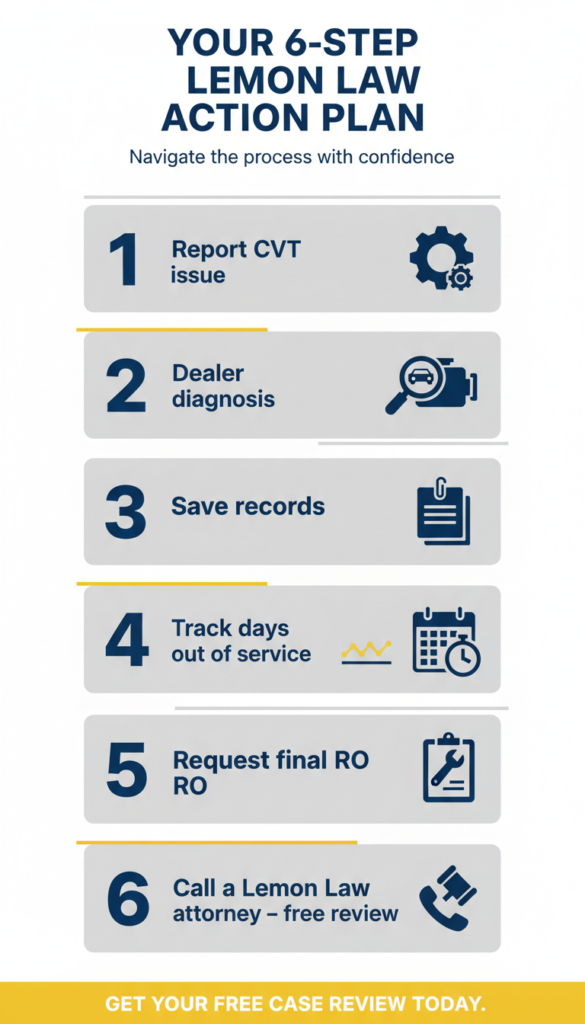 When your Nissan’s CVT transmission problems persist despite multiple repair attempts, you need a proven strategy to protect your rights. What steps should I take if my Nissan CVT transmission problems are not fixed after multiple repairs? Follow these six concrete steps to build a strong case and get the compensation you deserve.
Step 1: Schedule Another Dealer Visit Within 30 Days
Contact your Nissan dealer within 30 days of your last unsuccessful repair to schedule another service appointment. Use the exact same words to describe your CVT problems each time: “the transmission is shuddering,” “slipping during acceleration,” or “losing power completely.” This consistent language creates a clear pattern in your service records that strengthens your Lemon Law claim.
Step 2: Request All Repair Documentation in Writing
When you pick up your vehicle, ask for the complete repair order in writing, even if the dealer claims the problem is resolved. These documents become the backbone of your case. Never leave the dealership without written proof of what work was attempted and what problems were reported.
Step 3: Organize Every Document in One Place
Create a dedicated folder containing your purchase agreement, warranty information, all repair orders, towing receipts, loaner car agreements, and written communications with the dealer. This complete timeline often determines whether you win or lose your case. Keep both digital copies and physical documents for backup.
Step 4: Calculate Your Total Days Out of Service
Add up every day your Nissan spent at the dealership for CVT repairs. California law considers both unsuccessful repair attempts and cumulative service days when determining Lemon Law eligibility. Document pickup and drop-off dates, plus any days you drove a loaner vehicle due to CVT problems.
Step 5: File Federal Safety Complaints for Serious Issues
If your CVT problems create safety hazards like sudden power loss or complete transmission failure, report them to NHTSA immediately. This creates an official federal complaint record that supports your case and helps protect other drivers. The process takes just minutes online and strengthens your documentation.
Step 6: Contact a Lemon Law Attorney for Free Legal Review
Contact a California Lemon Law attorney for a no-cost case evaluation as soon as possible. You never pay attorney fees because manufacturers cover all legal costs when your case succeeds. Early legal guidance prevents costly mistakes and often leads to full vehicle buybacks or cash settlements that cover your actual damages completely.
Frequently Asked Questions for California Drivers
When your family’s safety depends on reliable transportation, persistent CVT problems create real stress and financial strain. These answers address the most pressing questions California parents face when their Nissan’s transmission keeps failing despite dealer repairs.
Can I get compensation if my Nissan CVT keeps failing after repeated repairs?
Yes, California’s Song-Beverly Act provides remedies when CVT defects persist despite multiple repair attempts. You may recover the full purchase price, plus taxes, fees, and incidental costs like towing. A California Nissan attorney can help determine your potential compensation.
How do I know if my Altima, Rogue, Sentra, or Versa qualifies for Lemon Law protection?
Your Nissan qualifies if CVT problems first appeared during the warranty period and continue after the dealer has made multiple unsuccessful repair attempts. Common qualifying symptoms include shuddering, slipping, or hesitation during acceleration. Document each repair visit and keep all service records. CVT warning signs can help you identify qualifying defects.
Why is hiring a lawyer important for Nissan CVT Lemon Law claims?
Manufacturers have teams of lawyers defending against claims, making legal representation essential for fair outcomes. An experienced attorney understands what constitutes sufficient repair attempts under state law and knows how to properly document your case. The Song-Beverly Act requires manufacturers to pay your attorney fees when you win.
Does my certified pre-owned Nissan qualify for Lemon Law protection?
Yes, if CVT problems arise during any remaining manufacturer warranty or certified warranty coverage. The key is when problems first appear and are reported, not when you purchased the vehicle. Keep documentation showing the defect occurred within the warranty period.
Will pursuing a Lemon Law claim cost me money upfront?
No, Lemon Law attorneys work on contingency, meaning you pay nothing unless you win. When you win, the manufacturer pays all legal fees and costs by law. You may receive 100% of your actual damages without any deductions for attorney fees. Contact us for a free case review to get started.
Ready to See If Your Nissan Qualifies? Get Free Legal Help Now
 Your Nissan’s transmission problems don’t have to burden your finances or compromise your family’s safety. When CVT issues persist despite dealer repairs during your warranty period, California law may entitle you to potential compensation or a vehicle buyback.
The good news is that you have options. Your repair records and documented transmission problems could be the foundation of a strong case. Many families resolve their Nissan CVT claims remotely without stepping into a courtroom, recovering up to 100% of their actual damages while manufacturers cover all legal fees.
Don’t let transmission problems continue disrupting your daily routine when California Lemon Law legal help for Nissan CVT issues is available at no cost to you. Contact The Barry Law Firm today for a free case review and learn about your potential compensation options.
 Email
Email
 Facebook
 Twitter
 Pinterest