
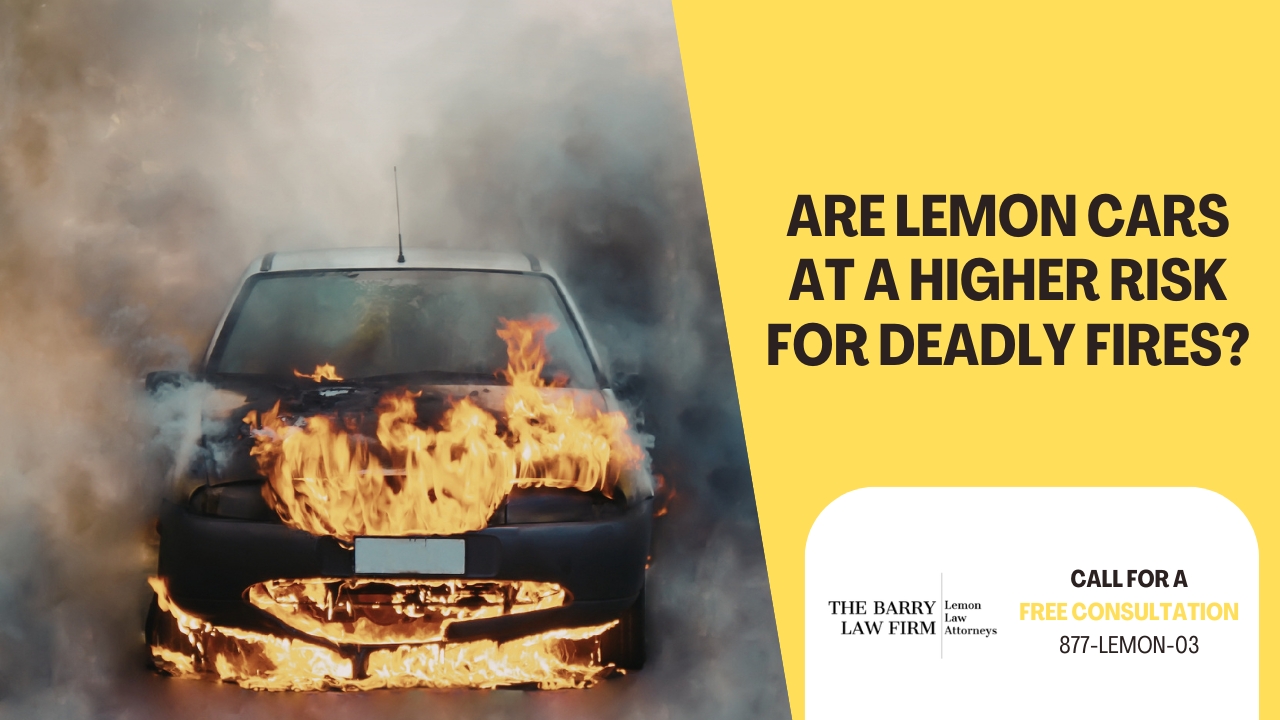
Drivers rarely expect a new or recently purchased car to carry serious safety hazards. Yet some vehicles hide severe issues that can lead to catastrophic outcomes, including car fires due to defects. These incidents place drivers, passengers, and nearby motorists in sudden danger.
It’s crucial to act quickly when your vehicle may have a defect that creates a fire risk. Fortunately, California law provides legal remedies for vehicles with substantial defects covered by the manufacturer’s original warranty that the manufacturer cannot fix after a reasonable number of attempts. Seeking this legal relief can help you get rid of a faulty vehicle that could spark or fuel deadly car fires.
Understanding how defects create fire risks can help you stay safe and take action as soon as you think there’s a problem. If you suspect your vehicle may qualify as a lemon, The Barry Law Firm can guide you through your options and help you protect your rights. Contact our firm today to speak with an experienced team ready to help you move forward.
Vehicle Fire Risks in Los Angeles, California
Car fires happen more often than many drivers realize. National fire data from the past several years shows that vehicle fires account for a large percentage of fire-related calls, with an annual average of over 215,000 vehicle fires occurring nationwide. Thousands of people suffer injuries or losses as a result.
In a dense, high-traffic region like Los Angeles, the risks are even higher. The Los Angeles County Fire Department responded to over 1,500 vehicle fires in one recent year. With long commutes and heavy congestion, a sudden fire on the freeway can place many California drivers in danger.
The leading factor contributing to national highway fires was a mechanical failure or malfunction. However, vehicle fires can develop from mechanical, electrical, or structural issues, including:
- Wiring problems
- Leaking fluids
- Malfunctioning battery systems
- Electronic system failures
When a car has a defect that increases the odds of ignition, the driver faces a threat every time they get behind the wheel. These defects can sit hidden for weeks or months before a spark triggers a fire. In Los Angeles, where summer temperatures soar, a minor defect can escalate fast.
The Link Between Defective Vehicles and Deadly Fires
Defective components can turn a routine drive into an emergency without warning. Vehicle fires may result from:
- Mechanical failure or malfunction is the leading contributing factor to vehicle fires. This can involve faulty engines, catalytic converters, radiators, cooling fans, exhaust systems, and brakes. These failures can result from design or manufacturing defects that existed when the vehicle left the assembly line.
- Electrical flaws are the next most common trigger. Modern cars rely heavily on electronics, which increases the likelihood of electrical failures. A loose connection or exposed wire near a vehicle’s power system can overheat and ignite surrounding materials.
- Defective fuel systems pose a serious threat. A cracked hose or misaligned seal can cause gasoline or diesel to leak onto hot engine parts. Once fuel reaches a heated surface, ignition can happen in seconds. These problems often develop quietly, giving drivers little warning before a fire starts.
- Hybrid and electric vehicles add another layer of risk. Defective battery cells can overheat and trigger thermal runaway, leading to spontaneous fires. These fires burn at extremely high temperatures and spread fast.
Common fire-linked defects include:
- Faulty relays
- Unstable battery modules
- Damaged wiring
- Malfunctioning fuel lines
Manufacturers must follow strict safety standards. When they fail, consumers face the consequences. Even a single defective part can create conditions for a deadly fire.
Vehicles Recalled for Potential Vehicle Fires
Over the past few years, many manufacturers have issued recalls due to fire risks. Some were because of electrical problems, while others had leaking fluids or battery issues. Here are a few examples of vehicles recalled for possible fire hazards:
- Hyundai Sonata and Kia K5 – Certain model years were recalled for a faulty fuel tank that could leak and lead to a fire.
- Hyundai Tucson – Many of the 2022-2024 model years were recalled due to an optional tow hitch wiring harness that may have been installed incorrectly, causing leaks and a fire risk.
- Ford Bronco Sport and Escape – Certain models were recalled for an underhood fire risk from fuel leaks caused by cracked fuel injectors.
- Ford F-150 Lightning – Some of the 2024 model year electric pickups were recalled because a short-circuit in their high-voltage batteries could cause vehicle fires.
- Lincoln Corsair and Ford Escape – Some plug-in hybrid models were recalled due to internal short-circuiting in the high-voltage battery cells, which poses a fire risk.
- Toyota Camry and Corolla Cross Hybrid – Certain models were recalled because a bolt within the hybrid powertrain could become loose and cause a fire.
- Jeep Wrangler and Grand Cherokee – Some plug-in hybrid electric vehicle models were recalled for a fire risk from battery pack cells with separator damage.
- BMW models – Various 2019-2022 BMW models were recalled due to an engine starter relay that may corrode, posing a fire risk from overheating and short-circuiting.
These recalls highlight how many systems in a vehicle can fail, creating fire risks. A defect may appear minor at first, but many lead to severe and life-threatening outcomes. Prompt action helps prevent tragedy.
How California’s Lemon Law Protects Consumers with Defective Vehicles
California’s Lemon Law gives strong protections to consumers who buy or lease defective vehicles in the state. If the manufacturer can’t repair a substantial defect after a reasonable number of attempts during the original warranty period, the vehicle may qualify as a lemon. However, the defect must significantly affect the vehicle’s safety, use, or value. A fire risk alone may justify quick action under the Lemon Law, especially when the issue prevents safe operation.
Fire-related defects create serious safety risks for drivers and passengers. Problems with vehicle electrical systems, fuel leaks, overheating batteries, or engine failures often fall under Lemon Law protections. When a mechanical or electrical defect raises the chance of ignition, it becomes too serious to ignore. The state’s Lemon Law for defective cars becomes crucial to help you get rid of the vehicle and protect yourself from serious safety risks.
Under the Lemon Law, the manufacturer may have to buy the lemon vehicle back and refund what you have spent on it. The law even requires the manufacturer to pay your legal fees if you win. These protections help consumers avoid driving unsafe vehicles and hold vehicle manufacturers responsible for releasing products with serious hazards.
When a Vehicle Qualifies as a Lemon
A vehicle may qualify as a lemon when it meets specific legal conditions, including:
- Warranty period – The defect must be covered by the manufacturer’s original warranty and fall within the warranty period.
- Reasonable repair opportunity – The manufacturer or an authorized dealer must have been given a fair number of attempts to repair the problem. If the defect poses a safety threat, such as a fire risk, just two or more repair attempts may be considered reasonable due to the urgency.
- Substantial impact – The defect must also substantially impair the vehicle’s use, value, or safety. Fire risks clearly fall under this category. A car that may ignite on the road or in a driveway cannot serve its intended purpose. Many consumers stop driving their vehicles altogether once they discover the threat.
An experienced Lemon Law attorney can review your case and help determine if your vehicle is a lemon.
Filing a Lemon Law Claim to Avoid Risk of Deadly Fires
When a defect involves a fire risk, quick action becomes essential because the danger can escalate without warning. If your vehicle qualifies as a lemon, the next step to pursuing legal relief is to file a Lemon Law claim.
The process begins with gathering all documentation related to your vehicle, its defect, any repair attempts, and your associated losses. For example:
- Repair records, recall notices, diagnostic reports, and manufacturer communications help demonstrate the defect.
- Keeping detailed notes about symptoms or warning signs can strengthen your claim.
- Repair records and service documents help show when the issue first appeared and how many times the authorized dealer tried to fix it.
- Receipts, bills, and invoices for out-of-pocket repair costs, towing expenses, rental car fees, and other related losses are crucial to support your claim for compensation.
From there, you can file your Lemon Law claim with the help of a skilled attorney. They can handle communication with the manufacturer, negotiate for a fair outcome, and take your case to trial, if necessary.
Managing these steps alone can feel overwhelming, especially when the vehicle is unsafe to drive. A defective car attorney can evaluate your records, prepare your claim, and present your evidence clearly. They can also protect your rights and help you stand up to large auto manufacturers who don’t have your best interests at heart.
If You Think Your Vehicle Is a Lemon, Reach Out for Help
Drivers often wait too long to seek support because they hope the manufacturer will eventually fix the problem. When a defect creates fire risks, delays can place your family in harm’s way. If your car shows signs of electrical issues, fluid leaks, overheating batteries, or similar problems, take the situation seriously.
A defective car attorney can review your repair history and identify whether your vehicle qualifies under California law. They will outline the next steps and explain which documents you need to gather. They will also communicate with the manufacturer on your behalf once your claim begins.
Legal guidance helps protect you from missteps that could hurt your case. A lawyer will handle deadlines, filings, and negotiations so you don’t have to manage them alone. If your vehicle is parked at home due to fire concerns, now is the time to act.
The Barry Law Firm Can Answer Your Questions
If you suspect your vehicle has a defect that increases the risk of ignition, you need legal help. The Barry Law Firm will review your situation and explain your rights under California’s Lemon Law in your FAST & FREE consultation. You can ask questions, discuss your concerns, and decide the best path forward.
And when you work with us, you can rest easy knowing we’ll do it without ever charging you anything. California’s Lemon Law requires the manufacturer to pay your legal fees in a successful claim, and you’ll never get a bill from us – no matter the outcome of your case.
Contact our firm today and speak with a team that understands the dangers connected to defective vehicles and deadly car fires.