
If your vehicle has been affected by the 2025 Hyundai recalls, you’re likely concerned about your car’s safety and reliability. While the recall issue should be repairable, that isn’t the case for every Hyundai Tucson or Santa Cruz. However, California’s Lemon Law may protect you if your recalled Hyundai has a significant warranty-covered defect that the manufacturer cannot repair after a reasonable number of attempts.
Contact an experienced California Lemon Law attorney at The Barry Law Firm today for your FAST & FREE consultation to learn about your rights as a vehicle owner.
What’s the Recall Issue?
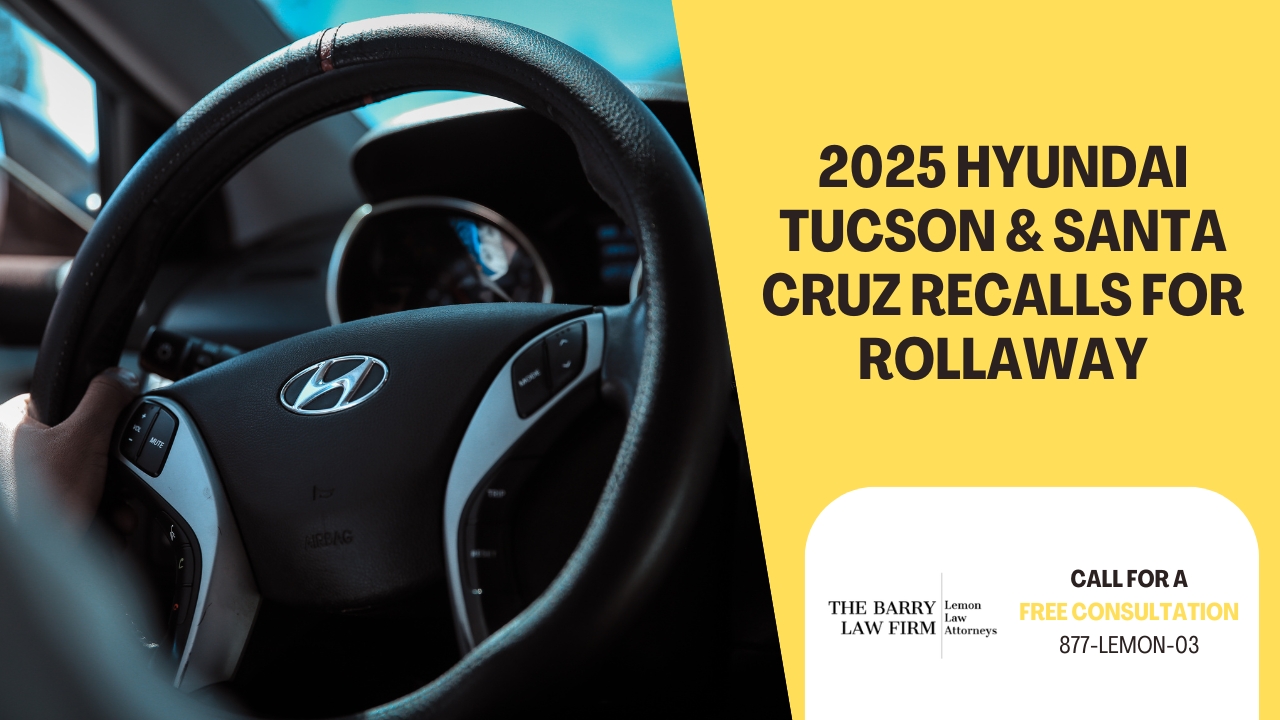
The Hyundai Santa Cruz recalls and the Hyundai Tucson recalls involve a serious safety concern that potentially allows vehicles to roll away unexpectedly. The Console Extension Wiring Assembly may have been improperly positioned near the transmission’s gear selector during manufacturing, interfering with the mechanical component that secures the shifter in place.
When this wiring bundle contacts the shift lever’s locking mechanism, drivers can move the transmission out of Park without pressing the brake pedal – a safety feature designed to prevent unintended vehicle movement. A rollaway car poses significant dangers, potentially striking pedestrians, other vehicles, or property and endangering both passengers and bystanders.
Hyundai’s Response
Hyundai Motor Company has issued Hyundai car recalls affecting more than 42,000 vehicles from the 2025 model year, including certain Santa Cruz crossover pickups and Tucson SUVs sold in the U.S. While the company says drivers may continue using their vehicles until repairs are completed, it strongly recommends engaging the parking brake every time the vehicle is parked.
Owners will receive official recall notices by first-class mail, with instructions to bring their vehicles to authorized Hyundai dealerships. Technicians will reroute the console extension wiring assembly to prevent interference with the shift lock mechanism, and all repairs will be performed free of charge. Hyundai has also agreed to reimburse owners who previously paid for related repairs.
For owners experiencing ongoing problems with their vehicles despite recall repairs, California’s Lemon Law provides additional protections. Vehicles that still have warranty-covered defects after the manufacturer makes reasonable repair attempts may qualify for potential remedies, including a buyback of the faulty vehicle.
Other Hyundai Models That Were Recalled
Hyundai has initiated a separate safety recall campaign affecting over 145,000 hybrid electric vehicles, including:
- 2022-2024 Hyundai IONIQ 5
- 2023-2025 Hyundai IONIQ 6
- 2023-2025 Genesis GV60
- 2023-2025 Genesis GV70
- 2023-2024 Genesis G80
These models face an entirely different technical problem related to their charging systems rather than transmission components. The electric vehicle recalls involve potential failures in the integrated charging control units (ICCU), which may prevent batteries from charging properly.
Service departments will inspect each vehicle’s ICCU and replace the component when needed. Technicians will also install updated software for the charging management system. Hyundai provides these inspections, replacements, and software updates without charging affected vehicle owners any fees.
What Do I Do If My Hyundai Is Recalled?
Taking immediate action when you receive a recall notice protects your safety. It also preserves your legal rights under consumer protection laws. Following the proper steps ensures you address the defect appropriately and document everything necessary for potential legal claims:
- Contact your dealership immediately. Contact your nearest authorized Hyundai service center as soon as possible to schedule your recall repair. Inform them that you’ve received a recall notice and provide your vehicle identification number (VIN) so the service team can confirm your vehicle’s eligibility and ensure the necessary parts or software updates are ready for your appointment.
- Document all recall-related communications and repairs. Save copies of your recall notice, service records, repair invoices, and any communication with Hyundai or the authorized dealership. If you encountered issues before the recall, collect documentation such as police reports, towing receipts, or prior repair records.
- Report any incidents or ongoing problems. If your vehicle rolled away before you received the recall notice or problems persist after the recall repair, report these issues to both Hyundai customer service and NHTSA. Your reports create an official record that may help other consumers and strengthen your position if you need to pursue legal action.
- Consult a California Lemon Law attorney. If multiple recall repairs don’t resolve your vehicle’s problems or you have other warranty-covered defects requiring repeated repair attempts, you may qualify for Lemon Law protection. An attorney can evaluate whether your situation meets the legal criteria for a Lemon Law claim.
Is My Hyundai a Lemon?
California’s Lemon Law protects consumers who purchase or lease defective vehicles that manufacturers cannot repair after a reasonable number of attempts while under warranty. The rollaway defect affecting 2025 Tucson and Santa Cruz vehicles clearly constitutes a substantial safety defect that could qualify vehicles as lemons if problems persist.
Your Hyundai may be a lemon if:
- The vehicle has a defect that significantly affects its safety, use, or value, which may include this recall issue.
- Hyundai makes a reasonable number of repair attempts for the same problem without resolving the issue or the vehicle is out of service for an inordinate amount of time.
- The defects are covered by the manufacturer’s original warranty and appeared during the warranty period.
You don’t need to accept a defective vehicle simply because the manufacturer issued a recall. If your Hyundai qualifies as a lemon, the manufacturer may be required to buy it back from you and refund what you have spent on it, including your down payment, monthly payments, license and registration fees, and incidental expenses like towing and rental cars.
Our California Lemon Law Attorneys Are Always Ready to Help
Dealing with a recalled vehicle creates frustration and safety concerns that manufacturers should address promptly and completely. When Hyundai’s multiple recall repairs fail to fix the problem or you experience serious warranty-covered defects beyond the rollaway issue, you need experienced legal representation to enforce your rights under California’s Lemon Law.
The California Lemon Law attorneys at The Barry Law Firm can thoroughly organize your claim, communicate with Hyundai on your behalf, and fight aggressively to demand the relief you deserve. Whether through negotiation or litigation, we work to hold manufacturers accountable when they sell defective vehicles that fail to meet safety and reliability standards.
Our attorneys have successfully represented countless clients against major manufacturers, securing justice for California consumers with lemon vehicles that dealers couldn’t repair properly. And we never charge our clients anything. California’s Lemon Law requires manufacturers to pay the consumer’s legal fees with a successful claim, and you’ll never get a bill from us – no matter the outcome of your case.
Don’t let Hyundai or any manufacturer dismiss your concerns about a defective vehicle. Instead, contact our experienced California Lemon Law attorneys today. We can protect your consumer rights and pursue the justice you deserve.
 Email
Email
 Facebook
 Twitter
 Pinterest