
The California Lemon Law provides vehicle owners and lessees with the right to seek legal relief when a car has serious warranty-covered defects that its manufacturer cannot fix after a reasonable number of attempts. The consumer can demand that the manufacturer buy the lemon back and refund what they have spent on the faulty vehicle.
The Lemon Law only applies to defects that significantly affect the vehicle’s use, value, or safety. As airbag defects can affect all three aspects, they can be covered by the state’s Lemon Law – although winning a case could prove more challenging than it should be.
Does your vehicle have an airbag issue that its manufacturer has not been able to resolve, even after several repair attempts during the original warranty period? If so, contact The Barry Law Firm for a FAST & FREE consultation with a Lemon Law attorney. We want to help you pursue justice, and you won’t have to pay anything to get the help you deserve.
What Can Cause Defective Airbags?
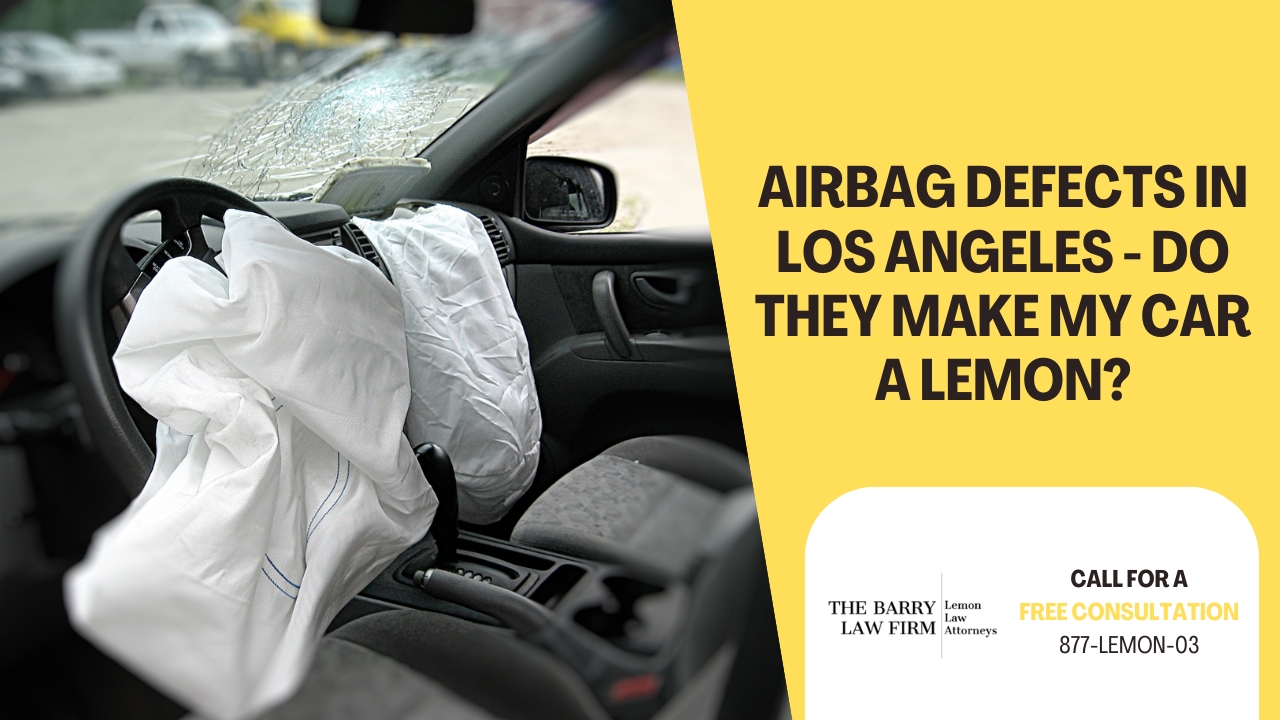
A motor vehicle’s airbag systems may suffer from a wide range of defects. Defective airbags may cause an airbag to deploy without a collision or fail to deploy in a crash. A faulty airbag can also deploy improperly, such as by blowing shrapnel or debris from the airbag system into the passenger cabin, deploying with excessive force, or deploying on a child passenger.
Specific airbag defects include:
- Design defects that make airbag systems inherently unsafe
- Manufacturing defects that cause airbag system components not to perform as designed
- Environmental degradation, such as exposure to heat or humidity, that can cause a breakdown in the airbag inflator materials
- Electrical issues, such as faulty wiring
- Faulty airbag inflators, such as excessive corrosion or degradation, or including an excessive amount of explosive
- Improper installation
- Use of substandard materials, including counterfeit or non-manufacturer-approved replacement parts
- Improper folding of the airbag, which can interfere with proper inflation
How to Tell If Your Car Has Faulty Airbags
Knowing that your airbags are faulty is crucial to your safety, as well as your passengers’. It’s obviously much better to know before the worst happens. There are a few ways you can identify defective airbags, including:
Vehicle Dashboard Lights
You may be able to tell if your vehicle has malfunctioning airbags when the car’s dashboard lights up with an airbag warning. Vehicles have sensors that check the functioning of airbag systems. When the sensors detect a malfunction or fail to detect the airbag system, the car may keep the airbag warning light on the dashboard illuminated or flash after starting the vehicle. An airbag warning light that fails to briefly illuminate along with the other dashboard lights when starting may also signal an issue with the airbag system.
Visual Inspection
You can also visually inspect your car for possible signs of faulty car parts in the airbag system. For instance, you can look for uneven panel gaps or bent panels on the steering wheel, dashboard in front of the passenger seat, and roof or side pillars (if the vehicle has side curtain airbags).
Recalls
In some cases, your vehicle manufacturer may issue a recall notice for your car’s airbag system. Affected vehicle owners should take these recalls seriously and follow the manufacturer’s instructions for getting it fixed. Recall repairs should be free, and you should get them done as soon as possible to protect yourself and your passengers.
Professional Diagnostic Scan
To be extra safe, you can take your vehicle to a mechanic for a professional diagnostic check of the airbag system. This may involve reading the car’s computer to see if it displays diagnostic trouble codes for the airbag system and visually inspecting airbag components for proper installation and signs of corrosion or premature wear and tear.
Do Faulty Airbags Make My Car a Lemon?
Under the California Lemon Law, a car may be a lemon if it has a severe defect that the manufacturer cannot fix after a reasonable number of repair attempts. A defect may qualify if it is covered by the manufacturer’s original warranty and started during the warranty period.
A faulty airbag can make a vehicle a lemon when it compromises the vehicle’s:
- Safety – A defect can compromise a car’s safety if it increases the likelihood of the airbag deploying prematurely or if the airbag’s inflation could cause shrapnel or other debris to fly into the passenger cabin.
- Use – A defect could affect a vehicle’s use if it increases the risk that the airbag will not inflate in a collision. An issue like that could prompt the National Highway Traffic Safety Administration (NHTSA) to issue a “do not drive” warning, advising vehicle owners not to drive their vehicles until they can obtain a repair for the defect.
- Value – Airbag defects can affect a vehicle’s value by reducing its resale value due to perceptions about safety risks.
The owner or lessee of a defective vehicle must take the car to the manufacturer or its authorized dealer for a warranty repair. If the manufacturer or authorized dealer cannot remedy the defect after a reasonable number of repair attempts, the vehicle may qualify as a lemon.
What constitutes a “reasonable” number of repair attempts depends on the specific circumstances. The number of attempts that would be considered reasonable to fix a defect that puts the driver, passengers, and others at risk of serious injury or death is typically two or more. An issue that doesn’t pose a significant danger may require additional repair attempts. A car may also automatically qualify if it spends an extended period in the shop due to a defect.
Cars That Have Been Recalled for Faulty Airbags
In recent years, there have been major recalls involving defective Takata airbags. With a total of 67 million recalled airbags from more than 42 million vehicles, the NHTSA has called it “the largest and most complex safety recall in U.S. history.” The NHTSA reports the problem has resulted in 27 deaths and over 400 airbag injuries.
Besides the widespread Takata airbag recall, numerous Honda and Acura vehicles have also suffered from a defect with the front passenger airbag’s weight sensor, which could cause the airbag to deploy with a child-sized passenger in the front passenger seat in a collision. Affected models included:
- 2020-2022 Honda Accord
- 2020-2022 Honda Civic Sedan
- 2020-2022 Honda HR-V
- 2020-2022 Honda Odyssey
- 2020-2022 Honda Pilot
- 2020 Honda Civic Coupe
- 2020 Honda Fit
- 2021-2022 Honda Civic Hatchback
- 2021 Honda Civic Type R
- 2021 Honda Insight
- 2020-2021 Honda Accord Hybrid
- 2020-2021 Honda CR-V
- 2020-2021 Honda Passport
- 2020-2021 Honda Ridgeline
- 2020 Acura MDX
- 2022 Acura MDC
- 2020-2022 Acura RDX
- 2020-2021 Acura TLX
Other vehicles that have had recent airbag-related recalls include:
- 2024-2026 Ford Ranger
- 2025 Ford Maverick
- 2021-2025 Range Rover Evoque
- 2024-2025 Mazda3
- 2024-2025 Mazda CX-30
- 2022-2025 Chrysler Pacifica
- 2022-2025 Chrysler Voyager
You can use the NHTSA’s website to look up whether your vehicle has an airbag recall using your vehicle identification number (VIN), your license plate number, or the vehicle’s year, make, and model.
What to Do If You Think Your Vehicle Is a Lemon
If you believe that your vehicle may qualify as a lemon due to faulty airbags, it’s essential to take prompt action to protect your rights under the California Lemon Law. You can do so by taking the following steps:
- Check your vehicle’s manufacturer’s warranty to ensure the defect falls within the warranty’s scope.
- Take your vehicle to the manufacturer or an authorized dealer for attempted repairs.
- Take photos or videos of any visual evidence of your car’s defect.
- Keep records of repair attempts, including the time your car spends in the shop, diagnostic confirmation of the defect, and the manufacturer’s or authorized dealer’s efforts to repair it.
- Save copies of bills, invoices, or receipts for out-of-pocket expenses you incur due to your vehicle’s defects, including towing fees, car rental fees, or taxi/rideshare fares.
- Gather documentation related to your vehicle’s purchase or lease, including your purchase, lease, or financing paperwork, as well as copies of your lease or loan payments.
You should also contact a Lemon Law attorney as soon as possible to discuss your legal options under the Lemon Law and learn how to pursue your rights. A lawyer can help you assemble the evidence and documentation you need to support your Lemon Law claim and handle all the details of your case on your behalf.
While you go about your life, your attorney can negotiate with the vehicle manufacturer to seek financial recovery for losses related to your defective vehicle. This recovery can include money for your:
- Down payments
- Monthly payments
- Registration fees
- Sales tax
- Financing charges
- Out-of-pocket repair costs
- Attorneys’ fees and costs
Contact Us Today for Help with Your Lemon
Severe warranty-covered airbag defects that your vehicle’s manufacturer cannot fix after a reasonable number of attempts may entitle you to financial relief under the California Lemon Law. An experienced lawyer at The Barry Law Firm can advise you on your rights and pursue your claim on your behalf. And we’ll do it all without ever charging you anything. The vehicle manufacturer is required to pay your legal costs with a successful claim, and you’ll never get a bill from us – no matter the outcome of your case.
Contact us today for a FAST &FREE consultation with a Los Angeles Lemon Law attorney to learn more about whether your vehicle’s airbag defects make your car a lemon.