
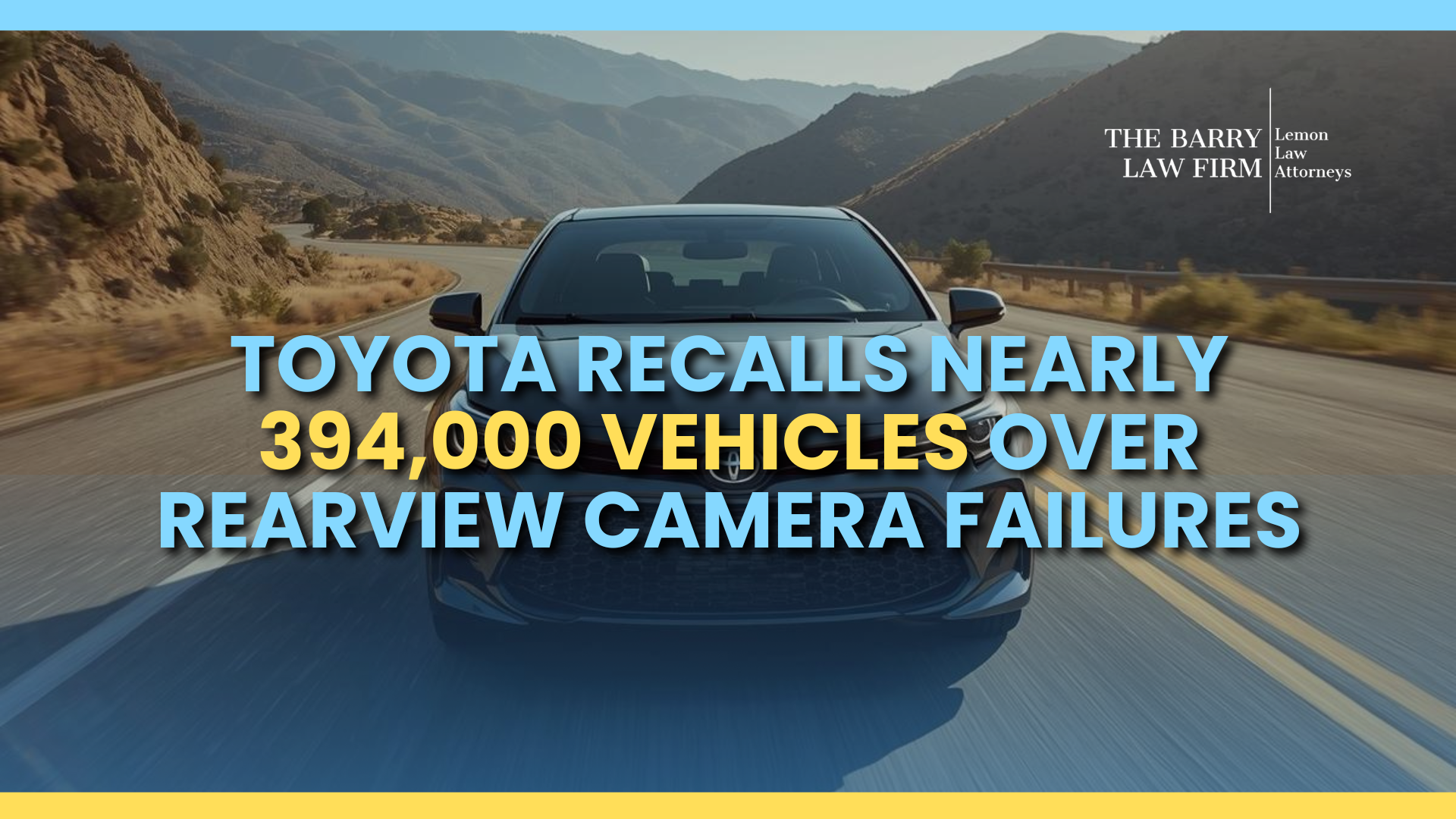
Toyota is once again under federal scrutiny after announcing a significant recall affecting nearly 394,000 vehicles across the United States. The defect involves intermittent rearview camera failures that may prevent the camera image from displaying while the vehicle is in reverse. According to the National Highway Traffic Safety Administration (NHTSA), this type of visibility impairment substantially increases the risk of collisions, especially in crowded or low-visibility environments.
This recall has captured widespread attention because it affects some of Toyota’s most popular full-size trucks and SUVs. These models were marketed as technologically advanced and equipped with enhanced safety features, leading many consumers to expect a superior driving experience. The sudden emergence of such a fundamental safety flaw has left owners questioning whether Toyota’s internal testing and software validation were as robust as promised.
The affected lineup includes the 2022–2025 Toyota Tundra, 2022–2025 Toyota Tundra Hybrid, and 2023–2025 Toyota Sequoia Hybrid. Given the sheer size of these vehicles, any reduction in rear visibility creates conditions where drivers may unknowingly place themselves, pedestrians, or nearby vehicles at risk.
Rearview Camera Failure Creates Serious Safety Risks
Rear visibility is one of the most critical components of safe driving, especially for vehicles built on truck platforms with large blind zones. Toyota’s recalled models may experience intermittent or total rearview camera failure, leaving drivers without visual guidance when backing up. NHTSA reports that this could occur without warning, causing drivers to reverse blindly into areas where obstacles or pedestrians may be present.
Several drivers have described moments where the screen remains black immediately after shifting into reverse, causing confusion and forcing them to rely solely on mirrors that provide incomplete visibility. Others reported that the camera display appeared delayed or glitched, offering only a partial or distorted image before shutting off entirely. In urban environments or crowded parking structures, even a brief lapse in visibility can create sudden and dangerous situations that escalate within seconds.
These failures undermine trust in modern safety systems and highlight how dependent today’s vehicles have become on digital interfaces. When these systems fail, drivers are left without the tools they rely on to navigate safely, especially during low-speed maneuvers where the rearview camera is their primary line of sight.
Toyota’s Software Update May Not Address Larger Issues 
Toyota has announced that dealers will perform a complimentary software update designed to correct the camera malfunction. This suggests the issue originates from programming deficiencies rather than hardware defects, although that distinction offers little comfort to affected owners. While software updates may resolve immediate symptoms, they may not address deeper structural flaws within Toyota’s multimedia platform.
The fact that multiple model years share the same defect indicates that Toyota may have missed critical issues during pre-production testing. If the root cause lies in shared software architecture, coding methods, or supplier-provided modules, the risk could extend beyond the vehicles currently listed in the recall. Owners of other models equipped with Toyota’s latest infotainment systems could eventually experience similar issues.
This repair strategy also raises questions about long-term reliability. Software patches do not always resolve underlying system instability, and recurring failures could signal a pattern that regulators and consumer advocates may revisit. Toyota’s ability—or inability—to deliver a permanent solution will likely influence future investigations and potential expansions of this recall.
California Drivers Face Elevated Safety Risks
California presents uniquely complex and congested driving conditions, making consistent visibility a necessity rather than a luxury. In heavily populated regions such as Los Angeles, even minor visibility reductions dramatically increase the likelihood of vehicle and pedestrian incidents. The size of Toyota’s Tundra and Sequoia models compounds this issue, as drivers must rely heavily on technology to navigate tight spaces, crowded lots, and residential neighborhoods with limited visibility.
Rearview camera failures, even if intermittent, create a scenario where drivers cannot predict whether the system will work in critical moments. A driver may trust the camera during routine use, only for the display to fail when reversing out of a driveway with children nearby or maneuvering around parked vehicles. This unpredictability creates a heightened sense of danger for both drivers and those around them.
Under California’s Lemon Law, repeated failures involving a vehicle’s visibility systems are treated as serious safety concerns. If Toyota’s recall repair does not permanently resolve the defect—or if a vehicle spends extended time at the dealership attempting repairs—owners may be entitled to compensation. The law protects consumers from being stuck with a vehicle that remains unsafe or unreliable despite multiple attempts to fix it.
What This Recall Signals About Modern Vehicle Software Reliability
The Toyota rearview camera recall highlights a growing challenge in today’s automotive industry: the increasing reliance on complex software ecosystems to operate basic safety systems. Vehicles are no longer mechanical machines alone; they are computer networks on wheels. When software fails—even briefly—the consequences can be just as dangerous as mechanical breakdowns.
Automakers are under immense pressure to integrate sophisticated infotainment systems, advanced driver-assistance features, and digital interfaces. However, rapid development cycles can lead to software bugs slipping through internal testing, especially when multiple suppliers contribute code that must function cohesively across the vehicle’s architecture.
This recall raises broader concerns about whether automakers are investing enough in long-term software reliability and quality assurance. If errors like this can occur in foundational systems such as backup cameras, it calls into question the stability of even more complex components like collision prevention, blind-spot monitoring, and lane-keeping technology. Consumers increasingly expect digital safety systems to perform flawlessly, but recalls like this demonstrate that automakers may still be struggling to meet those expectations.
Potential for Wider Issues Across Toyota’s Lineup
While this recall focuses specifically on rearview camera failures in certain Toyota trucks and SUVs, it represents a pattern that may extend beyond the listed models. Many of Toyota’s latest vehicles share the same digital display systems and software architecture, meaning a defect in one application could signal vulnerabilities elsewhere.
If Toyota’s internal investigation uncovers deeper problems with the software framework that manages camera feeds, the company may need to evaluate whether additional models are at risk of similar failures. Rear visibility systems are intricately linked to modern driver-assistance features, and any disruption could create a domino effect impacting sensors, alerts, or automated functionalities.
Historical recall patterns show that initial software-based recalls often expand as more drivers report ongoing issues. If Toyota’s update fails to correct the problem consistently—or if new symptoms arise after repairs—regulators may require the automaker to broaden the recall. For California consumers, this means staying vigilant and documenting any recurring problems, even after a dealership performs the update.
How The Barry Law Firm Can Help
At The Barry Law Firm, we specialize in helping California consumers take legal action against manufacturers when their vehicles fail to meet quality and safety standards. If your Toyota vehicle has been in the shop repeatedly for mechanical or safety issues — or if a recall repair hasn’t fixed the problem — you may be entitled to a refund, replacement, or cash compensation under California’s Lemon Law.
Lemon Law Expertise – We specialize in California Lemon Law cases and know how to hold manufacturers accountable.
No Upfront Costs – The California Lemon Law requires the manufacturer to pay our fees. That means, at The Barry Law Firm, we will never charge you, no matter the outcome of your case.
Proven Success – We have helped thousands of consumers obtain favorable settlements for their defective vehicles.
Personalized Attention – We handle all legal paperwork and negotiations so you don’t have to deal with the stress.
If Toyota’s repairs have failed to solve your vehicle’s problems, you may have a Toyota rearview camera defect Lemon Law case. Contact us today to explore your legal options.
Closing
Toyota’s recall serves as a reminder that even highly regarded manufacturers can release vehicles with safety defects that compromise driver confidence and put families at risk. When visibility systems fail—especially in large, modern vehicles equipped with advanced digital interfaces—the consequences can be immediate and severe. California consumers have powerful legal protections when automakers fall short of their obligations. If your Toyota continues to show rearview camera problems despite recall repairs, The Barry Law Firm is ready to help you evaluate your options and pursue the justice you deserve.
For many drivers, these types of recalls create long-term uncertainty, especially when the defect involves core safety features relied upon every day. A malfunctioning camera can make simple tasks like backing out of a driveway feel uncomfortable or even dangerous, and no consumer should have to tolerate that after investing in a new vehicle. When manufacturers offer repairs that fail to permanently resolve the issue, the responsibility should not fall on the consumer to simply “live with it.” California law was designed to protect buyers from these exact situations, ensuring that they do not bear the financial or emotional burden of a defective vehicle. If Toyota cannot deliver a lasting solution, affected owners have every right to seek compensation and hold the company accountable.
 Email
Email
 Facebook
 Twitter
 Pinterest